A New Melody or the Same Song?
How the history of executive compensation informs today’s unique landscape.
Published November 24, 2026
Published November 24, 2026
Across the leveraged buyout (LBO) craze in the 1980s to the dot-com boom and bust to the 2007-2009 financial crisis, the last five decades have seen various periods of rapid changes in executive compensation, influenced by shifting business, talent and regulatory factors. It may feel like these eras were “once in a lifetime” events, though it is growing clear that, while the history of executive compensation may not repeat itself, it certainly rhymes.
Era
Contributing Factors
Elevated Opportunity and Risk
Intense Talent Competition
Regulatory Shift
LBO Craze
x
x
Dot-com Boom
x
x
Financial Crisis
x
x
Current Environment
x
x
x
These historically significant eras demonstrate several common characteristics — elevated valuation multiples, an intense competition for specialized and executive talent, and a rapidly shifting regulatory landscape — that are also evident today. In addition to this unique confluence of factors, the current macroeconomic and geopolitical environment continues to throw wrenches into boards’ long-term planning abilities. Persistent volatility seems to be the new business norm.
If history is any indication, the field of executive compensation is primed for another rapid evolution, and boards will need to be ready for change. The dynamics at play offer both challenges and opportunities for boards willing to craft a new tune and reexamine and reshape their executive compensation practices.
Elevated business opportunities and risks.
Across the current broader market, investors are signaling expectations for robust future growth, though risks abound. Much of the current optimism is anchored in possibilities unlocked via AI. Though the magnitude, timing and breadth of AI’s impact remain uncertain, there will inevitably be both winners and losers. Companies are racing to ensure that they become the former rather than the latter.
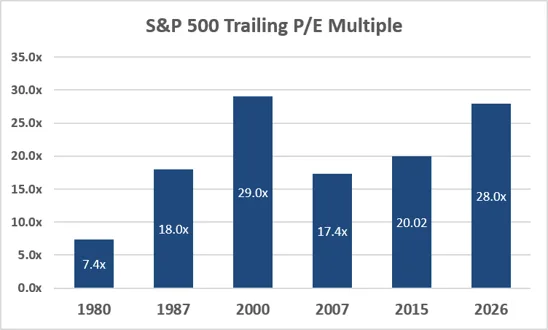
Elevated valuations signal a belief in strong market opportunities, though there is also tangible downside risk, as modest swings in perceived strategic positioning or future guidance can send share prices tumbling. Recent trailing price to earnings (P/E) multiples for the S&P 500 are approximately 28 times, approaching the peak multiples of roughly 29 times seen during the dot-com era, and well above pre-crash levels from 1987 and 2007.
While revenue and profit enhancement expectations surrounding AI transformations are generally more tangible than those of dot-com companies, elevated expectations are applying significant pressure on go-forward performance objectives. Compensation committees may be tempted to push management teams to pull out all the stops with aggressive compensation plans, but lofty performance goals may go unmet, and then the whole song falls flat. Given the market opportunity, some companies will be able to sing their song of success proudly, though it is unclear whether all will carry the same melody.
During the dot-com boom, elevated market valuations and intense competition for tech talent drove large increases in executive pay, which eventually led to stock option expensing and a major rebalancing of companies’ equity strategies. In today’s environment, there is a familiar tune of upward pressure on executive pay, though companies are utilizing different strategies to engage their leaders and encourage strong performance. In some cases, there is a material uplift in target pay, including through “moonshot” awards that are intended to drive exceptional rewards and performance. However, many companies are holding course or using more limited enhancements to achieve their desired value proposition.
Intense competition for talent with the vision to capitalize on AI opportunities and navigate today’s other rapid changes is reflected in accelerated growth rates at the upper end of market pay curves. Within the S&P 500, CEO pay in 2025 for companies in the upper quartile grew nearly twice as fast as median pay, and the growth rate for the upper 10% of payers grew at more than four times that of the median. These higher pay levels are not limited to technology- or AI-focused firms. A growing number of companies across industries have implemented aggressive compensation arrangements for both incumbent leaders and external hires, reflecting the perceived value of winning in the new frontiers of opportunity and the high cost of falling behind.
An increasingly common strategy for supporting elevated pay levels is to use “moonshot” awards that require the achievement of ambitious long-term value-creation goals. Unlike the prior “moonshot” phases in the early 2020s, the current songbook applies to both founders and non-founders. History tells us that many such awards will not be earned, though the size and number of awards being offered are pushing overall executive compensation levels upward. Other companies are simply holding course or making more modest pay strategy moves. An example of more modest change while maintaining the core pay framework is where some tech companies are using rapid-vesting equity awards to deliver steady equity value, blurring the line between equity and cash. As companies seek creative strategies to differentiate themselves, the prevailing definition of “market-competitive” is stretching what was once considered prudent and responsible compensation design. Whether this trend of pushing boundaries continues remains to be seen.
Potential shifts in the say-on-pay landscape and a fragmented shareholder environment
Prior regulatory shifts drove significant changes in executive pay, often contributing to rapid increases in pay levels. For example, a 1993 rule that introduced the summary compensation table added visibility to competitive pay levels and drove increases for many. The new 162(m) rules at the time also capped non-performance-based pay, creating a de facto $1 million limit on CEO salaries and pushing companies to use equity more aggressively and accelerate overall pay increases. Today, market forces, regulatory shifts and a more fragmented shareholder environment could create conditions for another burst of change in executive compensation.
In today’s hypercompetitive business and talent environment, market pressures are seen as the primary driver of rising executive pay. At the same time, the SEC’s proposed actions to simplify pay-related disclosures could exempt as many as 80% of U.S. publicly traded firms from say-on-pay voting rules and thus remove one check-and-balance on executive pay. If these proposed rules are implemented, the negative consequences of low or failing say-on-pay outcomes may also be less clear.
Pressure from several directions is also reducing the influence of proxy advisors such as Institutional Shareholder Services and Glass Lewis. Many shareholders have developed their own mechanisms for assessing executive pay and performance, though this creates a more fragmented evaluation landscape. Vote results from the 2026 proxy season indicate that receiving an “against” recommendation from a major proxy advisor continued to result in historically comparable double-digit-plus declines in say-on-pay support, though this song may change in 2027 and beyond.
Recent large CEO packages indicate an increased willingness to make bold pay decisions that carry greater say-on-pay risk. Current market pressures and the regulatory environment seem to be creating space for discussions of larger compensation numbers and alternative pay structures, with more focus on specific business and talent objectives. If enough companies take meaningful action, this moment could presage a future shift in regulatory practices that could be more constraining than the frameworks currently in place.
Learning From the Past, Owning the Future
Even if we’ve heard many elements of this tune before, elevated market opportunities and risks, intense talent competition and a shifting regulatory landscape are rapidly moving forces that amplify both the potential rewards of getting executive compensation right and the risks of getting it wrong. The speed of today’s changes — from new technologies to geopolitical instability — may make it seem impossible to keep up. However, it is crucial to remember that what is “right” or “wrong” is not a one-size-fits-all concept, and companies can align their pay actions with their unique circumstances without chasing the crowd.
History never quite repeats itself, as today’s confluence of factors from disparate eras attests. But in every era of volatility we’ve discussed, one thing remains constant: the companies that thrive during periods of change are those that hold fast to their core values and compensation philosophy as their guiding lights. No matter how executive compensation history “rhymes” going forward, we believe that this verse will never change.
Brant has 20 years of executive compensation consulting experience. Brant has led engagements with Fortune 500 firms and addressed rewards needs for pre-IPO firms, start-ups, and PE portfolio firms.
His experience covers a range of industries, enabling a broad view of market practices and supporting the ability to create highly effective rewards solutions.
Prior to Semler Brossy, Brant worked at Mercer. He received his MBA from UCLA Anderson and holds a degree in human biology from Stanford University.
Blair Jones has 30 years of executive compensation consulting experience. She has worked extensively across industries and has deep expertise in advising boards on company transitions, significant investor concerns, and an expanding human capital management mandate. Before joining Semler Brossy, Blair was the practice leader in Leadership Performance and Rewards at Sibson and an Associate Consultant at Bain & Company.
Blair holds the designations of Certified Benefits Professional (CBP), Certified Compensation Professional (CCP), and Certified Executive Compensation Professional (CECP). Since 2013, Blair has consistently been named to the D100, NACD Directorship Magazine’s annual list of the most influential people in the boardroom. Blair currently serves on the Mohawk Valley Health System board and leads its Women’s Giving Circle, helping direct philanthropic support to community health initiatives. She also serves on the advisory board for M3 Placement & Partnership.
Of Interest
Consistently named to the D100, NACD Directorship Magazine’s annual list of the most influential people in the boardroom community, including directors, corporate governance experts, regulators, and advisors, since 2013.