Compensation committees can benefit from understanding the target-setting practices of S&P 500 companies.
In corporate performance management, the approach companies take to setting financial targets significantly impacts the success of incentive programs by balancing pay-for-performance alignment with employee motivation and retention. Companies often aim to establish goals that are ambitious yet achievable, fostering strong employee engagement while maintaining shareholder confidence. Shareholders typically prefer alignment between corporate guidance and target goals, emphasizing a shared commitment to a pay-for-performance incentive strategy.
Building on this need for ambitious yet attainable objectives, incentive goals are specifically designed to motivate and drive high performance. Stretch goals can appeal to shareholders by showcasing ambition, but boards must carefully balance this ambition with retention concerns. When goals are overly challenging or repeatedly unattainable, participants may become discouraged, impacting productivity and morale. To explore this balance, we evaluated how companies set financial targets relative to external guidance and assessed their achievement of those targets. This analysis helps identify how boards navigate the trade-offs between performance alignment, motivation and retention.
Here, we highlight key trends and strategies in target-setting for a subset of S&P 500 companies. This study focuses on companies that use identical metrics in their annual incentives as they do in issuing public guidance (with no adjustments), focusing on revenue, earnings per share (EPS) and earnings before interest and taxes (EBIT)/operating income. By examining the past two fiscal years, this study sheds light on how companies align their performance targets with guidance provided to shareholders and how these decisions impact payouts.
Findings Show Effort to Balance Goals with Market Expectations
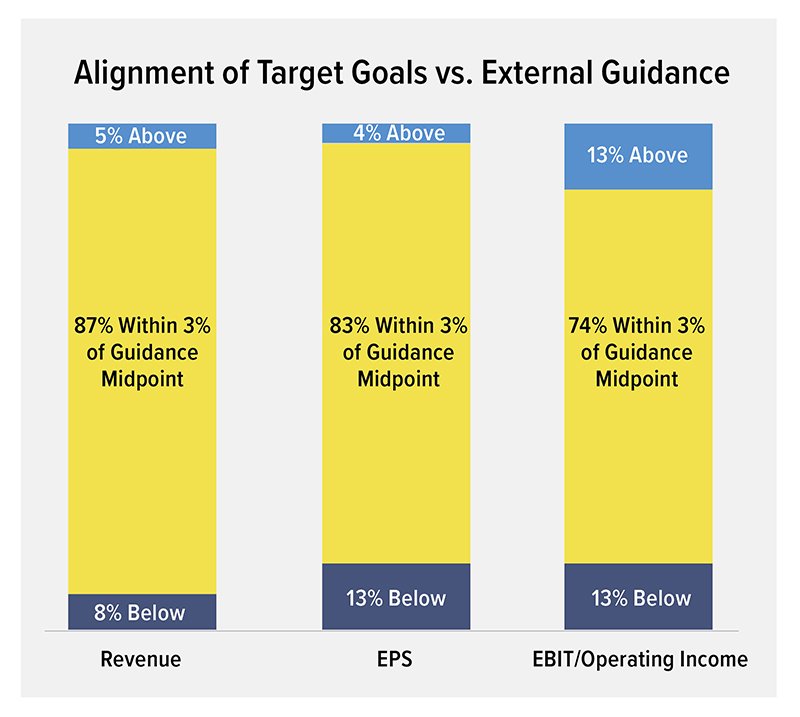
Regardless of measure, most target goals are within 3% of the guidance midpoint. Across all three metrics — revenue, EPS, and EBIT/operating income — approximately 85% of companies set their performance targets within 3% of the midpoint of their guidance. This level of precision indicates a deliberate effort to balance ambitious yet attainable goals that align with market expectations.
There is a relatively even split between those who set their targets above or below midpoint. The study reveals a relatively even split between companies that set targets above the midpoint of guidance and those that set them below, with a slight skew to below guidance targets. Although a vast majority of companies are within a 3% spread from guidance, the upper end of the sample has a smaller variance than companies who set targets at the lower end compared to guidance. For instance, over the past year, no company in the sample set a target exceeding 6% above the guidance midpoint. Conversely, some companies established targets more significantly below the midpoint of guidance, with deviations up to 10% below guidance.
Disclosures did not describe in depth the rationale for straying from midpoint guidance levels. However, a few examples of companies that set targets below guidance pointed to a challenging macro environment near their goal-setting disclosure. Revenue metrics tended to have less variance from the guidance midpoint than EPS and operating income since revenue is a larger number and often easier to estimate than bottom-line metrics.
Regarding specific metrics, the findings show a range of target-setting depending on the metric.
Positioning vs. guidance midpoint was consistent year-over-year. Another notable finding is the consistency with which companies set their targets year-over-year. Most organizations maintained a stable approach to target-setting compared to guidance. Only four companies in the study had a greater than 3% variance on targets relative to guidance over the two-year period. This stability suggests that many companies prefer to stick to consistent methodologies, ensuring predictability and alignment with long-term strategies.
Payouts tended to be higher for companies who set targets below guidance. The relationship between target placement and payout outcomes was also found to be impacted by the target-setting methodology. Companies that set targets below the midpoint of guidance generally provided higher payouts than those set at guidance midpoint, and companies that set targets above guidance midpoint provided lower payouts. When the target was set below guidance — more than 3% lower — the average payout was 11% higher versus target than companies that set near the guidance midpoint. For companies who set guidance more than 3% above guidance, payouts versus target over the two-year period were 24% below those that were near the guidance midpoint. These findings are counter to what many shareholders might hope to see, particularly if year-over-year results are declining.
Considerations Committees Should Discuss with Management
Financial targets should generally align with the corporate guidance midpoint as a foundational starting point. If there is a divergence between targets and guidance, it is important to have a clear rationale explaining the differentiation. To facilitate this evaluation, the committee should consider a series of questions to ask management when targets deviate from guidance.
For targets below guidance
- What is the reasoning behind setting targets below the guidance midpoint?
- What year-over-year improvement does the goal imply?
- Does the guidance midpoint reflect extraordinary performance or just expected performance?
- How does the target compare to analyst consensus expectations?
- How do historical payouts inform this decision?
- Should the board consider limiting the upside payouts to maintain balance and fairness?
For targets above guidance
- What is the justification for setting targets above guidance?
- Does the goal represent extraordinary performance or just expected performance?
- How does the target compare to analyst consensus expectations?
- What change in payouts should be required above the target level to receive increasingly higher levels of performance?
- How will this approach impact motivation and retention, particularly if the targets are perceived as overly ambitious?
- These questions help ensure that the rationale for target-setting is well-considered, aligns with organizational objectives, and supports a fair and motivational incentive structure as well as pay and performance alignment.
Conclusion for Aligning Targets with Guidance in Incentive Programs
The study underscores the delicate balance required in setting financial performance targets within S&P 500 companies. By aligning targets closely with guidance, organizations can foster transparency and maintain credibility with shareholders while motivating employees. However, the nuanced differences in target placement — whether slightly above or below guidance — highlight the complexities boards face in addressing both market expectations and internal morale.
Findings suggest that while most companies align targets within 3% of the guidance midpoint, the rationale behind deviations is often tied to external challenges or strategic priorities. Importantly, the relationship between target-setting and payouts reveals a key dynamic: setting targets below guidance tends to result in higher payouts, a factor that could destabilize pay-for-performance alignment and dissatisfy shareholders.
To achieve an optimal balance, companies should establish clear, well-communicated rationales for their target-setting decisions, ensuring alignment with both long-term strategies and current market conditions. By addressing the considerations outlined in this analysis, boards can support incentive programs that are ambitious yet achievable, reinforcing both performance and retention in an evolving business landscape.
View the full article as it was originally published or download a PDF version of it.